The Place
At the northern end of India, beyond the Himalaya, lies a vast expanse of land with rugged terrain and harsh weather. The culture is considered Tibetan, the population Buddhist, and the location ’sensitive’. It sits between Tibet and the Himalaya, which made it an important center for trans-Himalayan trade, hence the name "pass-country" or "country of passes." ’La’ for ’pass’ and ’Dakh’ for ’land/country’ — with their roots in Tibetan — give rise to the name Ladakh. This region is one of the most unique parts of the country, with its distinct culture and history.
Ladakh’s unique history is marked by trade, invasions, and wars between its South, North, and Central Asian neighbors. Famous for its Pashmina goats and trade routes, the region was ruled by the Namgyals from 1490–1842. The Dogra army, led by General Zorawar Singh Kahluria, conquered Ladakh during the Dogra–Tibetan war of 1841–42, leading to the region’s incorporation into the princely state of Jammu. Later, it became part of the Indian state of Jammu and Kashmir.
Since Independence, Ladakh’s experience has been characterised by peripherality, war, and clashes. The recent constitutional changes, including the abrogation of Article 370, have led to Ladakh becoming a Union Territory. After a long struggle, Ladakh is now partially under central government administration, free from the political dominance of Jammu and Kashmir that began 180 years ago. The fight for regional power continues as Ladakh seeks the sixth schedule under the Indian constitution and statehood to grant its people more political power in the region.
What this study asks
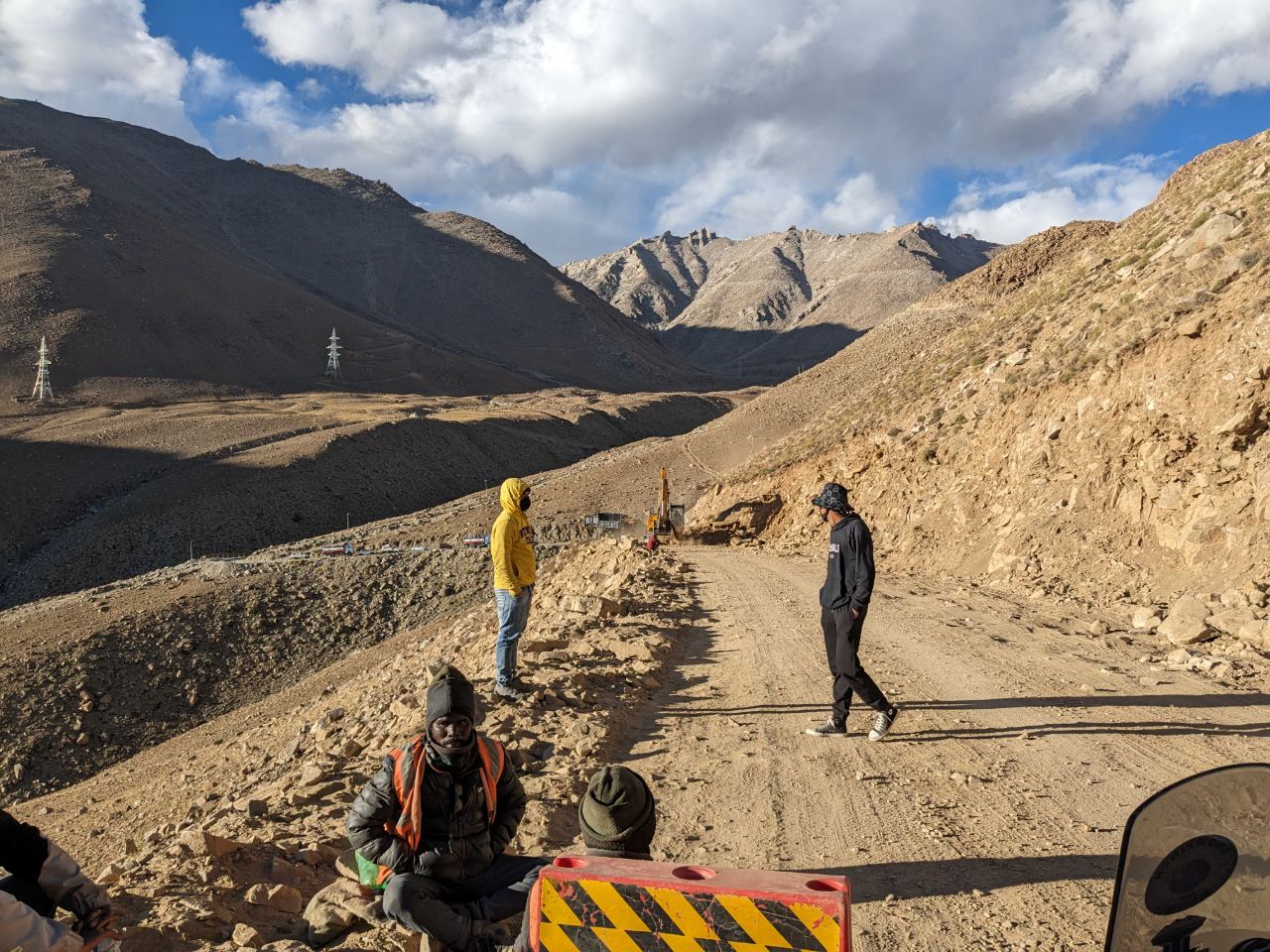
This study asks about the road development in Ladakh. Specifically focusing on how road building happens in the Himalaya at the backdrop of disputed borders and forever unravelling geopolitics between different Himalayan countries. Here, human labour is essential to maintain the steady connectivity on these border roads.
I ask, what border roads are, and what kind of a space they create? Are the road workers, their labour, and presence all a part of the roads? Are they the infrastructure?
Further, within the context of the allure of the Himalaya, and the accessible fear (Macfarlane) of climbing mountains, and the fairly recent political sketching on the Himalayan terrain, people use adventure tourism (pre-roads) to create a sense of alternate reality where man, machine, and the map are in a symbiotic relationship.